
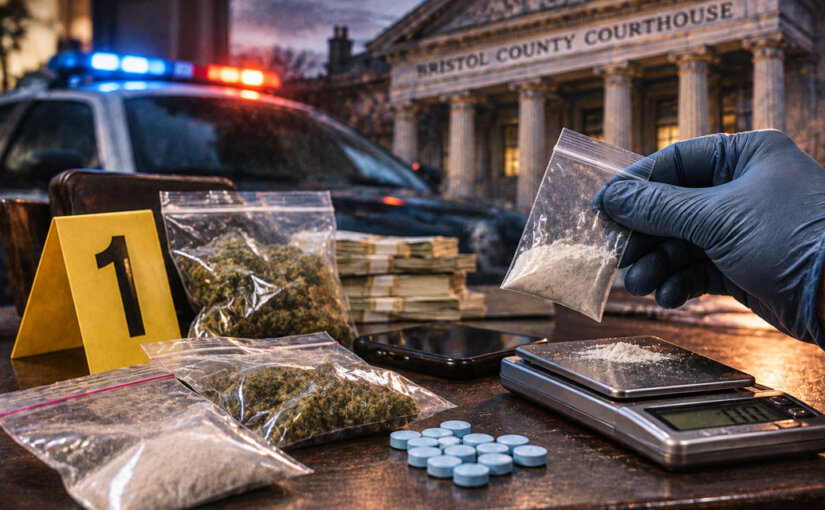
In Bristol County, MA, evidence that matters most in drug crime cases includes seized substances, drug residue, packaging materials, digital communications (such as texts or emails), surveillance footage, cash believed to be drug proceeds, witness and informant statements, and forensic lab reports. The collection, testing, documentation, and legal challenges surrounding this evidence can determine whether charges are dismissed, reduced, or lead to conviction.
What To Know At A Glance
- Physical evidence such as drugs, residue, and packaging must follow strict collection and documentation protocols.
- Digital records including texts, call logs, and surveillance videos often play a central role in drug prosecutions.
- Chain of custody is required to prove evidence integrity from seizure through trial.
- Expert witnesses and crime lab results are key in establishing the identity and quantity of suspected drugs.
- Improperly seized or mishandled evidence can be suppressed and excluded at trial.
- Witness and informant credibility is closely scrutinized by Bristol County courts.
Chain of Custody Key Definition
Chain of custody refers to precise documentation and handling requirements for physical evidence—each handoff from seizure to trial is recorded to guard against tampering and to prove authenticity in court.
Facing Uncertainty in Bristol County Drug Crime Evidence
If you’re reading this, you or someone close to you is likely facing a drug charge in Bristol County. The moment police take bags, phones, cash, or even everyday objects as evidence, panic sets in—what exactly are they going to use against you? This fear deepens when you’re handed paperwork listing various items or witness names, especially if the details seem one-sided or unclear.
Most people in your situation are worried about more than conviction—they’re afraid of the unknown. Will every text or call with friends be turned into evidence? What if the 'evidence' is just a residue or a misunderstood message? People understandably fear wrongful conviction, harsh sentencing, or never being able to challenge what’s been seized. You may be searching for clarity about your own options before accepting a plea, trying to prepare for a bail hearing, or even understanding what the prosecution actually has.
This post breaks down what evidence really matters in drug cases brought in Bristol County, how the law treats it, where evidence gets challenged, and what cannot be undone if you act too soon. It won’t offer a guaranteed outcome or replace a defense attorney’s advice, but it will help you find out what’s possible in your own case.
Key Types of Evidence Critical in Bristol County Drug Crime Cases
In Bristol County, prosecutors build drug cases using a mix of physical, digital, testimonial, and scientific evidence. Each category has its own importance, legal requirements, and openings for a strong defense. Here’s what you need to know about each type and how a defense attorney can use the law to challenge their strength.
Physical Evidence: Collection, Testing, and Chain of Custody Importance in Bristol County
Physical evidence—like the actual drugs, drug residue on surfaces, paraphernalia (scales, baggies, packaging materials), and cash—is central to drug prosecutions. In Bristol County, police must follow detailed procedures to collect and log these materials. Every step, from the scene to the evidence room, must be documented to keep the chain of custody intact. If the evidence passes through too many hands without proper logs, or if the testing methods are flawed, a criminal defense attorney can move to suppress it. Even small mistakes—such as unsealed bags or unclear transfer records—can call the integrity of the evidence into question and may lead to it being excluded in court. Prosecutors rely heavily on crime lab analysis to identify and weigh substances, but defense lawyers often push for independent testing, especially if there’s a chance of contamination or mislabeling.
Digital and Electronic Evidence: Admissibility and Use in Bristol County Drug Cases
Digital records such as texts, call histories, social media messages, GPS data, and surveillance video can be used to show drug transactions, communication networks, or patterns of behavior. In Bristol County, police must obtain proper search warrants for electronic evidence. If the warrant is overly broad, lacks probable cause, or the seizure extends beyond its scope, a defense attorney can challenge the admissibility of any digital material. Surveillance videos—whether from public cameras or private property—must also be authenticated and shown to be untampered. Courts carefully scrutinize how this evidence was obtained and preserved. If there’s any weakness in the process, key communications or footage may be excluded entirely.
Witness and Informant Evidence: Role and Credibility in Bristol County Drug Prosecutions
Testimony from witnesses, co-defendants, or confidential informants often supplements physical evidence. Bristol County courts are aware that informants may have criminal histories or stand to gain from their cooperation. Their credibility is always a point of attack for the defense, with cross-examination targeting inconsistent statements, deals made in exchange for testimony, or any sign of bias. Defense attorneys can often introduce evidence of informant unreliability or challenge their identification process, weakening the prosecution’s overall case.
Legal Procedures Affecting Evidence: Search Warrants, Suppression Motions, and Challenges in Bristol County
The process by which evidence is seized is every bit as important as the substance itself. In Bristol County, police must usually secure a valid search warrant or fit within recognized exceptions (such as consent, plain view, or exigency) to gather evidence lawfully. If your rights are violated—whether the warrant is defective, the search exceeds its scope, or officers fail to properly document their actions—your attorney can file a motion to suppress. Timing is critical: these motions must be raised early or important rights may be lost. Diligent attorneys analyze every step and attack weaknesses that could eliminate key evidence.
Proof Standards and Evidence Thresholds for Drug Conviction in Bristol County
The legal standard in Massachusetts, including Bristol County, requires the prosecution to prove each element of a drug crime beyond a reasonable doubt. For simple possession, prosecutors must show knowledge and control over the substance. Intent to distribute usually depends on circumstantial factors—packaging techniques, presence of scales, large sums of money, or surveillance observations. For trafficking, both the quantity and clear evidence of intent are required. Effective defense strategies often focus on highlighting alternative explanations, weak connections, or inconsistencies that create reasonable doubt.
Expert Witnesses and Lab Evidence: Reliability and Challenges in Bristol County Drug Trials
Expert testimony from crime lab analysts is essential for identifying the substances involved and confirming their weight. The reliability of these experts—and their labs—can be contested based on methods, equipment, or historical errors. Past Massachusetts cases have exposed crime lab scandals, making judges wary and defense motions for independent analysis more common. The defense may hire its own experts to dispute the findings or highlight issues with the prosecution’s procedures.
How Evidence Quality Impacts Sentencing and Case Outcomes in Bristol County Drug Crimes
Stronger evidence typically leads to tougher charges, fewer plea options, and harsher sentences—especially if aggravated circumstances are shown (proximity to schools or minors, large quantities, or prior offenses). On the other hand, compromised or poorly handled evidence may result in suppression, weakened bargaining power for the prosecution, probation instead of jail, or outright dismissal. Long-term, evidence flaws can influence probation conditions, eligibility for diversion, or success on appeal. Every element should be closely reviewed by your criminal defense attorney before you make any plea or trial decision.
Common Mistakes When Evaluating What Evidence Matters in Bristol County Drug Crimes
Many defendants assume that all evidence listed by police will be admitted at trial. In fact, even seemingly incriminating items—drug residue, packaging, digital messages—can be challenged if there are breaks in the chain of custody, flaws in digital collection, or mistakes in the warrant. This misunderstanding often leads to hasty guilty pleas or waiving key defenses before a criminal defense attorney can review the evidence.
Another common error is waiting too long to contest the admission of evidence. Often, deadlines for suppression motions or independent analysis pass quickly. Some people provide new incriminating statements (on jail calls, to police, or to friends) not realizing these can become evidence themselves, foreclosing important defensive options.
Instead, you should insist on a line-by-line review of the evidence with a defense attorney—never assume any item or statement is unchallengeable. Avoid speaking about your case on monitored calls, and never agree to a plea or make statements without full evidence disclosure.
What the Law Says
Massachusetts law, enforced by Bristol County courts, has strict standards for what can be used as evidence in drug cases. Physical and digital evidence must be collected under the Fourth Amendment and Article 14 of the Massachusetts Declaration of Rights. Massachusetts courts apply the 'chain of custody' rule to all drug evidence, and both Massachusetts General Laws Chapter 94C (controlled substances) and case law regulate the admissibility of expert testimony and digital evidence. If evidence is collected or handled improperly, your attorney can seek to have it excluded. Ultimately, the prosecution must prove all elements of a drug crime beyond a reasonable doubt, using only evidence the court finds credible and admissible.
People Also Ask
Drug evidence issues in Bristol County, MA trigger dozens of practical questions about how police, labs, and courts actually handle and assess the facts of your case. Here are direct answers to the most frequent concerns.
How The Main Paths Compare
| Evidence Type | Typical Impact in Bristol County Drug Cases |
|---|---|
| Physical Evidence (drugs, packaging, residue, paraphernalia) | Used to establish possession, quantity, or intent to distribute; must be properly documented and handled |
| Digital/Electronic Evidence | Corroborates transactions or communications; requires valid warrants and can expose procedural defenses |
| Witness/Informant Testimony | Bolsters or undermines prosecution depending on credibility; especially vulnerable to cross-examination |
| Lab/Expert Reports | Confirms substance identity, purity, and weight; mistakes may be grounds for challenge |
| Chain of Custody Documentation | Determines whether physical evidence will be accepted by the court |
Examples Of How This Can Play Out
Example Scenario 1
Situation: Police find prescription pills in a shared apartment where no one claims ownership.
Likely Outcome: Unless law enforcement or prosecutors can link the pills directly to a specific person—through fingerprints, admissions, or digital evidence—proving control or possession may be impossible, creating a strong defense for dismissal.
- Location of the drugs
- Absence of exclusive control or admissions
Example Scenario 2
Situation: A person is arrested after arranging a meeting via text message and is found with multiple baggies, a scale, and significant cash.
Likely Outcome: Prosecutors will present both physical and digital evidence to suggest intent to distribute, making legal objections to the search procedure, digital evidence collection, or warrant contentions vital to the defense.
- Validity of the search warrant
- Chain of custody records
- Digital evidence integrity
Frequently Asked Questions
What types of physical evidence are commonly used in Bristol County drug crime prosecutions?
Drugs (actual substance), packaging materials, paraphernalia like scales or baggies, cash suspected as drug proceeds, and residue are most common. Each item must be logged, tested, and linked by chain of custody for admissibility.
How does Bristol County treat digital evidence such as text messages or call logs in drug crime cases?
Digital evidence—texts, call logs, emails, GPS, and social media—must be obtained through specific, valid search warrants. Illegally acquired or poorly authenticated digital records can be suppressed if the defense files timely challenges.
Are police informant statements always admissible in Bristol County drug trials?
No. Informant statements are subject to credibility challenges based on motive, criminal history, or rewards. Skilled defense attorneys often highlight inconsistencies or bias so jurors scrutinize their claims.
What is required for the prosecution to prove intent to distribute drugs?
Prosecutors look for circumstantial evidence beyond possession—like divided packaging, scales, large sums of cash, and communications pointing to transactions. Typically, multiple forms of evidence are presented to build intent.
How do suppression motions work to challenge drug evidence in Bristol County?
Suppression motions ask the court to exclude evidence obtained through unlawful searches, improper warrants, or chain of custody lapses. Your attorney must act quickly, as these motions have strict deadlines in Massachusetts courts.
Can the defense get independent lab analysis of drug evidence in Bristol County?
Yes. You have the right to request independent scientific testing of substances. A criminal defense attorney may use outside labs to spot errors or contamination in prosecution lab results.
Is circumstantial evidence enough for a conviction in a Bristol County drug crime case?
Sometimes. If the circumstantial evidence overwhelmingly points to guilt and there is no reasonable alternative, it can support conviction. But a skilled defense attorney works to highlight doubt or alternate explanations.
Are prior drug convictions admissible as evidence in a new Bristol County drug case?
Generally, no. Prior convictions cannot be used to prove current guilt except in specific circumstances—like impeachment or some pattern offenses—which are rare and strictly limited by law.
How does Bristol County handle contaminated or poorly handled evidence?
If chain of custody is broken, contamination is found, or documentation is missing, evidence may be suppressed entirely. Judges often exclude evidence that cannot be shown to be reliable or untampered.
What kind of expert testimony is allowed regarding drugs in Bristol County courts?
Expert testimony typically comes from forensic chemists or lab analysts to identify and weigh drugs. The defense may challenge their credentials, lab practices, and even call their own independent experts for rebuttal.
How long does Bristol County retain drug evidence?
Drug evidence is generally retained until all appeals are resolved and the case is closed. Evidence must remain available for independent analysis throughout the legal process.
Can cash found during an arrest be used as direct evidence of drug dealing?
Significant cash is often introduced to suggest sales, but by itself is not conclusive. The defense may argue for innocent explanations—recent paycheck, business income, or other legitimate sources.
How is drug residue handled as evidence in Bristol County cases?
Residue may be tested in the same way as bulk substances. Its presence alone is rarely enough to prove intent to distribute, but can support possession charges if linked to you through context or location.
Are packaging materials used as evidence in Bristol County drug arrests?
Yes. Baggies, wrappers, scales, and similar items are often introduced to imply distribution. The defense can challenge whether their presence is truly tied to an intent to sell, rather than personal use or innocent purposes.
Key Takeaways
- Physical, digital, and testimonial evidence play unique and vital roles in your Bristol County drug case.
- Just because evidence is listed by police does not mean it is automatically admissible—many types are open to challenge.
- Chain of custody and procedural questions are powerful points for a criminal defense attorney to attack.
- Quick action is critical—suppression motions and evidence review deadlines come up fast.
- Your case deserves a detailed review of every evidence item before making any decisions.
Get Guidance on Evidence in Your Drug Crime Case
If you're charged with a drug crime in Bristol County, MA, don't guess what evidence the prosecution can use against you. A criminal defense attorney can challenge illegal searches, improper evidence handling, and unreliable witnesses. Protect your record and your future—make sure every piece of evidence is reviewed before you act.